About the Trip
Italy was the second place in Europe I wanted to ride around after Germany. I will start with the photos and the route itself, but the subject of how traffic is organized in this country became very interesting and painful for me, so I put it at the very end.
I will try to describe the route in a way that makes repeating it require little planning. We were very happy with the result.
It came out to 25 days and 6100 km, and this was my longest trip. Of the major cities, we skipped Milan and rode past it because we had already been there and decided not to spend time on it. We also skipped both big islands, Sicily and Sardinia, because we did not have enough time. We did not go to Calabria either, the toe of the boot, because there was nothing there that interested us. We skipped Rimini because it was too close to San Marino, and we wanted to spend two days in Venice after that. Spoiler: that was a mistake.
Bamberg
A small, quiet town where pensioners heavily dominate among the tourists.
On the first day we left only toward evening, so we decided to spend the night here. Only on the second day did we ride through Austria, past Innsbruck, which we already knew well. If you have not been there, I strongly recommend staying for another day there too. Then we reached the Dolomites. We stayed in Colle di Fuori; the choice was based purely on the hotel’s price to quality ratio. There are many similar villages nearby.
The hotel. The place is surrounded by mountains, across the road there was a picturesque little church, and in the next building an orchestra was rehearsing, filling the mountain air with a sense of coming adventure.
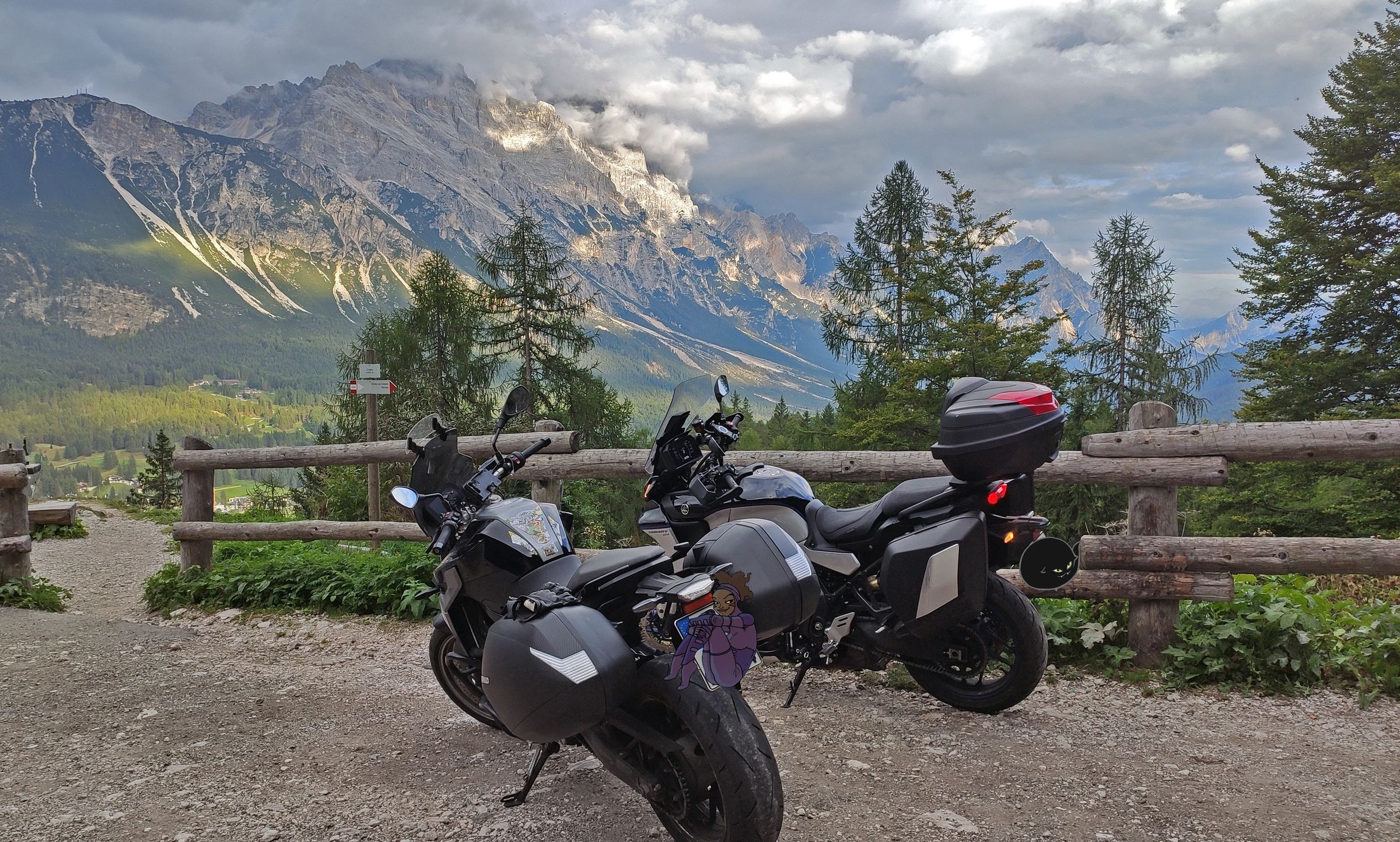
Dolomites, Day 1
Curves. Mountain roads made entirely of sharp turns with steep climbs or drops. Paradise for many motorcyclists. Two-wheelers dominate. By the way, there are almost no young motorcyclists, mostly old daredevils. Lots of motorcycle-themed cafes. And the motorcycles differ from Germany: many Tracers.
The Dolomites live from morning until 5 p.m. By evening almost nothing is open. You need to rethink your schedule and become the earliest of early birds, otherwise everything will be closed. This also applies to the rest of Italy, though to a lesser extent.
Lago di Braies. A beautiful lake with jade-colored water. Motorcycle entry costs 5 euros, a boat for 5 people costs 50 euros. It is worth spending a couple of hours here.
Tre Cime di Lavaredo. Three peaks. Entry costs 20 euros. For the first time, I dropped the bike after stopping and putting my foot on slippery limestone. You need 3-4 hours at the top; visiting is mandatory. This is a key place in the Dolomites. Unfortunately, fog stopped us from fully enjoying it. It was 8 degrees up there.
For this trip, you absolutely should take an action camera and a filming drone if you have them. If you do not, think about why you do not, and fix that oversight.
Dolomites, Day 2
Again, you need to get up very early, otherwise you will not make both places. Start with Langkofel, or Sassolungo, entering via Funivia Piz Sella. I did not make it there, but it turned out that by chance we photographed the place from every side, so I consider that chapter closed.
You need to go up Langkofel by lift, even though Google stubbornly tries to route you along animal trails.
After that comes Seceda. A calm, meditative place. I regret not taking a burner with me; it would have been nice to drink not beer there, but a mug of coffee.
Lake Garda
Verona did not initially look interesting to explore. We decided to ride along the western edge of Garda and chose one tourist point to visit: the waterfalls and gardens of Cascate del Varone in Riva del Garda.
We rode along Garda with our mouths open, constantly interrupting each other over the intercoms: “Look at that, holy shit!” Unfortunately, I did not have an Insta360-style camera to capture that “holy shit,” and Lake Garda is exactly what pushed me toward buying one. We enjoyed the ride as a process, not as a means of getting to the next point.
After a seafood restaurant, we spent the evening on the beach. Sometimes you simply want to relax and contemplate. Here it happens by itself.
And the next morning arrived. It would be good to swim in the local waters, so we did, at Spiaggia Desenzanino.
On the way we decided to stop in Sirmione. It was memorable; I recommend it.
Scaliger Castle is there, and if you have free time, I recommend spending about 40 minutes visiting it.
Lake Como
If Lake Garda looks like a dick, Como looks like a clitoris, including the inner part. Again, a wonderful place and wonderful impressions.
People are relaxed, resting by the lake, fishing. For some reason I thought this was the canonical pastime here.
Then we went to Bellagio, the most touristy place on Lake Como. At the motorcycle parking lot, people left helmets with headsets and GoPros right on their motorcycles, without cables. This would create a contrast with the situation in Central Italy later.
We tried to get out of Bellagio. The navigator stubbornly led us into places with one-way streets where we could not go in that direction. We started looking for a way out, the navigator suggested one, and… there was a staircase up to the road. With steps, yes. I probably could have ridden up it on both bikes, but we decided not to risk it. We wrestled around, turned the bikes in place, and rode back against traffic, putting ourselves in fate’s hands.
We stopped at a shop on the way and spent the evening on the shore, enjoying the sunset. A perfect evening with mountains, lake, sunset, and motorcycle boots.
Milan
We rode past Milan. The road was simply awful. More precisely, it was beautiful, narrow, winding, with many tunnels, but 50% of the traffic consisted of trucks: lorries and fuel tankers. It was very scary because the trucks had their own schedule and drove at their maximum permitted speed, as if the limiting signs did not exist.
We did not go into Milan this time, as we had already been there. We rode past it, and past Genoa too. We did not particularly like the city: too many wide, empty streets, uncomfortable. In that it reminded me of Minsk. There was no negativity either, it was just somewhat boring relative to expectations. I recommend only one day here.
A huge number of traffic lights, all ignored.
Castello Sforzesco. This is the first place you should visit.
The Duomo, the cathedral. Also one of the main sights, though it will not take much time. Cathedrals like this are very similar; if you have seen five, you have seen them all.
Porta Sempione, the city gate. It is interesting to walk around behind it.
And I will repeat it again. Milan is not a bad city if you include it in a larger trip. I still would not advise going there separately unless it is for an event like EICMA.
Riviera
After the road from Como through Genoa, we were fairly tired. A light rain began. Italy had been delighting us with views, but here on the Riviera they became similar. I really wanted to ride through all the towns here, but the weather got in the way.
A little house on a mountain with a sea view. So close, yet so far.
We only stopped in Sestri Levante for booze, then rested from the road in the room. The road up here, to the small village of Cerisola on the mountain slope, was very enjoyable all four times we rode it. The last 50 meters were at a 30-degree incline, and there was a sign banning traffic for everyone except locals. Apparently because of the number of accidents that had happened there.
The next morning the rain ended, and we were ready to continue the trip.
Cinque Terre
The main place in Cinque Terre, Monterosso al Mare, was slightly disappointing. Yes, the road down from the mountains was very interesting, but the town itself was pale, and the beaches did not impress us because we had expected much more. But yes, it is still cool here.
Fog, absolutely insane fog on the way to Vernazza. And pouring rain too. We had to skip several next points and stopped in a city with the telling name La Spezia.
On the way, there was a funny cactus story. Their fruits are sold in stores. And here they were right next to us, all you had to do was reach out. The fruit was soft, ripe. Happy, I handed it to my wife. Then we spent half an hour pulling out splinters with tweezers, which fortunately were in a camping Swiss knife. Hundreds of soft splinters that immediately break off and remain deep in the skin. We did cut open the fruit that evening; it turned out to be tasty.
In the evening we decided to visit another town in this region, Manarola, to see what we had seen in photos. Beautiful, but there would be even more beautiful things later.
The route went over a mountain pass, and I had not seen such a serpentine even in the Dolomites. Absolutely sharp turns with a major climb, via Fabio Filzi.
In Manarola, a downpour began and night fell. I realized I would not be able to return by the same road I had used to get there: on such a serpentine there would not be enough visibility or tire grip. It is a local road, one lane for both directions. I recognized it immediately on the way back: “No fucking way, where is the detour?”
Pisa. Florence
On the way to Pisa, we stopped in Marina di Carrara. “Our” yacht is there. Well, “ours” as in bought with our money for one oligarch. A depressing place, because of that yacht.
Pisa. Just Pisa. A couple of hours are enough here, but they are needed to take silly photos for the personal archive. How could you not?
We did not go into Livorno and went straight to Florence. I would have liked to stay in Florence longer: two days and one night, not just one night. An excellent place for an urban break in Italy.
Tickets to the David museum need to be bought in advance; the queue is huge. So we skipped it and went to explore the city. That takes about two hours.
In the evening, we got a magnificent sunset.
Hadrian’s Villa
On the way to Rome, we stopped at a ruined but recently excavated imperial villa in Tivoli.
Plan about two hours for this place, no more.
Unusually ordinary vegetation and views. An unfounded feeling of nostalgia without any references to my own past. As if it were mine, native, although I have never lived in places like this.
Rome
Rome deserves at least two full days, or three nights. It is the most astonishing city I have ever been to, saturated with history. But there is a nuance: all the magic of Rome disappears when you come there a second time. So on the first visit you need to do as much as possible, and then never return.
Chains as thick as a finger on rotten scooters. It seems like the chains are even more expensive than the bikes they are tied to. It is clearly unsafe here. As in Naples. There are many beggars, including with children, even infants. That is simply impossible to imagine in Germany.
Of course, one of the days should start with the Colosseum, first thing in the morning.
Tickets are bought up by resellers, and you will have to accept that and buy from them. Many guide-barkers and barking-guides on site will solve this problem.
Pay special attention to the weather. If it is July, it will be damn hot, so take care of drinks and hats. On our trip we took special care of drinks, so from early morning we started with mandarin liqueur right in the park near the Colosseum, and then refilled hiking bottles with wine on schedule ^_^.
Then climb Palatine Hill, the main hill of Rome. The views of the Forum are magnificent, a complete immersion in history. This is a separate part of the ticket that includes the Colosseum, but we liked it even more. There are tickets just for the Colosseum; do not take those. Take the biggest set.
The Trevi Fountain is absolutely worth visiting. It is the most crowded place in the city, and not by accident. A couple of Subway sandwiches are worth eating here while looking at the water. Peaceful, despite the bustle around.
The second full day should definitely be devoted to the Vatican and the squares. Big backpacks are not welcome, so it is worth having small bags that will be allowed into the most interesting places. Wine should be poured into hiking bottles.
You can climb to the top of St. Peter’s Basilica. The way up is fairly exhausting in the heat, but it is absolutely worth it.
And from above there are mind-blowing views over the whole city.
After that, it is worth visiting the Sistine Chapel. Unfortunately, we could not get into it, but judging by the photos, that was a real shame.
In the evening, walk through all the squares and collect experience from the obelisks. This is everything on the maps that starts with “piazza del”. All the popular ones deserve attention, and this is exactly what the second half of the second day is for. Between them, restaurants of course.
Pay special attention to the Zona a traffico limitato. We violated it unknowingly, but nothing happened to us. And it is not even certain that we violated it: maybe, due to Italian carelessness, the necessary signs simply were not on our route.
You also need coins in Rome. I do not remember why, but you really need them.
Naples
The city itself is the worst place for road traffic in the world among the places I have been. Vietnam quietly smokes on the sidelines. The city roads are paved with 30 cm tiles, all crooked, with edges and corners sticking up. Slippery. Locals race around at 2-3 times the speed limit, ignoring traffic lights and the direction of one-way streets. Here, half the cars are smashed on several sides, and the other half on all sides. Very dirty.
We stayed in Scafati, a nearby town, and compared with Naples it is paradise. Although everything is relative, and the traffic is still awful.
Avernus. Or Averno. A place whose name is familiar from Baldur’s Gate 3 and its backstory. My wife ran the tabletop campaign “Descent into Avernus,” so she did not miss the chance to take a photo with this volcanic lake next to the sign with its name.
Vesuvius, Pompeii
Vesuvius. A dark page of history. And the city of Naples beneath it. In 1805, during another eruption, most of Naples was destroyed and 26 thousand people died.
Another phrase from The Witcher 3 comes to mind: “You never learn, do you?”
Vesuvius has not puffed for a long time. Long means since 1944. That year, two towns died, San Sebastiano and Massa, with 27 thousand victims.
And yes, you definitely need a drone here. And I could have taken one more thermal bag with a couple of…
Tickets must be bought online. They are “released” every 10 minutes for the next few hours to counter resellers. You absolutely need to do this in advance; there is no connection on the volcano itself.
Pompeii. You MUST take a map and study it. We did not see even half the sights.
What remains of those swallowed by gas and ash.
Amalfi
The Amalfi Coast is one of those places you absolutely must visit in Italy. This should not even be debated. We decided to ride around the whole peninsula along the perimeter, turning back toward Pompeii before Salerno.
Bagni Regina Giovanna. A grotto with a view of Vesuvius. Straight to the heart. It is very cool to swim here, especially in the narrowing part with waves.
Fifty-five minutes from the hotel in Pompeii, on a mountain serpentine, the clutch cable jammed. Yes, in 2023 motorcycles they still install those instead of hydraulic lines. I managed to start and rode the whole way to Pompeii without touching the clutch. I felt like a superhero. First I poured beer over the adrenaline, and only then lubricant over the clutch. And yes, the views from the mountains over night cities are simply magnificent; we rode past the Valico di Chiunzi viewpoint.
Matera, Road to Lecce
The landscape changed unimaginably. It became desert-like. Trees disappeared. Around the road there were only cacti. Dry riverbeds. If a yellow filter had suddenly appeared, I would not have been surprised.
On a hill near the road stood an entirely beige city, like something from childhood cartoons about Baghdad. And we were heading to another like it, but more famous: Sassi di Matera. I greatly regret that we did not go from the very morning; then there would have been enough time to spend two hours walking through the houses carved into the mountain. An unexpectedly cool place.
We had lunch in a restaurant by the church. Unexpectedly excellent prices and excellent service, which you rarely expect from a place you visit once in your life.
We are going to Lecce. Almost everywhere on the roads the speed limit is 40, although in Germany the same roads would have no limit. Locals violate it and average 90. The town is pleasant and cozy. It does not have the recklessness of Naples or even Rome. The city center is very atmospheric, with many excellent restaurants and a wonderful price to quality ratio.
It is worth spending two nights here.
Beaches near Lecce
In the morning we went to the beaches, and that was the plan for the day. A beautiful plan for a beautiful day.
Azure water, absolutely transparent. Here you simply must have a swim mask. The best beaches in Italy, forgive me Amalfi and Riviera.
We stopped at a tiny park with a self-explanatory name: Grotta della Poesia. Once again I was glad I had good motorcycle sneakers. If I had changed shoes, I would simply have cut my leg on the protruding sharp rocks.
Next to it is Torre Sant’Andrea beach. The best place I have swum in Europe.
In Italy you need to try seafood tartare. I am squeamish about such things, so I agreed only to shrimp. Juicy, melting in the mouth. But of course I will not repeat it.
We wanted to spend the evening again in comfortable Lecce. The historic city center is small, and the concentration of interesting things there is excellent: a 12th-century castle, Roman theater and amphitheater, both from the 1st-2nd century, cathedrals, a park…
Grotta Piana, Bari, Molfetta
Grotta Piana was one of the points I definitely wanted to visit.
Unfortunately, I was not the only one with that idea. There are a lot of people here. The place is beautiful and the beach is good, but I cannot recommend it precisely because it is overcrowded.
We also visited Bari. We had a Quest there: one of the players from my wife’s roleplaying group asked her to prepare a gift box, with a fairly good quality combination lock. We successfully completed the first part of the quest: retrieved the box from the apartment. For the second part, we needed to use analytical abilities or brute force. We found another way: sleight of hand. No matter how good a rotary combination lock is, it will last no more than a couple of minutes if you know what to do.
Unfortunately, I did not take any photos there, relying on my wife, and she spent the whole time fiddling with the gift box.
We wandered through the streets, went into San Sabino Cathedral, and ate tiramisu. The Castello Svevo di Bari citadel is monumental from the outside, but inside it turned out to be very boring.
We checked in at Molfetta, in the most symbolic house in the city, the one in all the photos, for the lowest price of the whole trip.
There is nothing to do here, and perhaps it would have been better to stay in Bari. On the other hand, it is cheaper, calmer, and a new experience.
Manfredonia
I deliberately routed the road across the spit where Torre Pietra stood. What did I expect to see? Azure waters on both sides. But all the azure remained farther south, and on the inner side of the spit there were only salt flats. The tower was disappointing too.
We are in Manfredonia. Truly another fishing town, and one with a large port. And we simply went to the beach.
I do not recommend doing two overnight stops in Molfetta and Manfredonia; that was our mistake. Choose just one place, and spend the day somewhere else.
San Marino
One evening is enough for this place, from 15:00 to 19:00 up on the mountain in the historic center. And it is truly a gem you do not expect to find here. We were delighted.
It is a separate state with its own laws. And speed cameras are everywhere here, and nobody breaks the rules.
After sunset we decided to devote the evening to Italian cuisine, but next door there happened to be a sushi restaurant. And not just happened to be there: it turned out to be the best one we had ever visited.
Unfortunately, we did not visit Rimini. I would have liked to see that city too, but the trip had to be compressed.
Venice
Once, this was a delightful, beautiful, romantic place. But tourism killed it. Extremely high prices for lousy quality. All infrastructure is aimed at one-time tourism and squeezing money out of those seduced by the city’s fame. Crowds and queues everywhere. An ordinary Heineken in a shabby restaurant can cost 12 euros for 0.5. Venice even managed to beat Kreuzberg in Berlin for the amount of shit on the streets. Definitely the most expensive and worst place of the trip.
Yes, too much negativity, even though there is plenty of beauty in Venice. But precisely the abundance of that beauty brought popularity, and that popularity brought the negativity.
There are many islands here, and it is worth taking care of tickets for the river tram, the vaporetto. Even if you buy them online, they still need to be activated in a kiosk.
Rescue services, police, mail: everyone travels by boat. Logical, but still surprising.
One of the square-shaped islands is a cemetery. We left a cigarette for Brodsky.
A day and a half in Venice is enough. Ideally fit it into one night because of accommodation prices. Do I regret staying for two days? Yes. But I do not regret coming; it was an unusual and new experience, even if it smelled a bit.
On the way back, we saw the collapsed railing of a bridge. A day and a half earlier a bus had fallen, with many victims. Those are the people who rent accommodation on the mainland, and a bus takes them to the island early in the morning and brings them back in the evening.
Graz
We returned to the original side of the Alps. In a couple of hours, the weather jumped by -20 degrees from summer into autumn.
And what a relief it was to enter Austria, where traffic rules finally start working again.
I very much regret not having a good camera for filming while riding; there were interesting views here with no opportunity to stop. In particular, a very strange dirty-mint-colored river, almost completely dried up.
In Graz I got sick and spent the whole day lying in the hotel with a fever. However, I had been to this city several times already, and a day and a half plus one night is enough to see it.
The Lurgrotte cave impressed me the most. From my winter trip:
Sometimes you look for silver and find diamonds. In Graz, my Elena and I rented a car and went to see snowy mountains. One of the attractions in the mountains is Lurgrotte, so we decided to drop in. There were only a few caves and a locked gate leading somewhere into a utility area, judging by the carts. In one of the grottos there was a narrow passage leading deeper. Total darkness, soft earth underfoot, probably springs, which after a couple dozen meters changed to stones as the passage widened. Another couple hundred meters forward and the passage widened even more, then another descent, and we had to climb over stones in complete darkness. And then before us was a huge cave chamber. Colossal: about 150 meters along the long side and 30 meters in radius, yes, the size of a skyscraper laid against a nine-story building.
We saw all sorts of things over our couple of kilometers underground: bats, a group of out-of-breath speleologists in full gear stunned that we were in total darkness with only phones, and a tour group that turned on the lights, yes, it turned out there were lights, right at the moment when I wanted to be alone with nature… And the fact that we discovered this place on our own was a lucky accident that turned the event into an exciting adventure.
A couple of hours before sunset, go to Schlossberg and walk there. I recommend taking the elevator through the inside of the mountain.
After sunset, look at the night city, descend from Schlossberg on foot by the stairs, cross the bridge, and head to the pub Brot & Spiele. I recommend the Belgian IPA Raging Bitch.
Czechia
We head to Czechia, and right by the border is Mikulov Castle. In photos the castle looked more impressive. We decided not to go inside. Although in its time, the Czech castle that impressed me most was Loket.
On the way to Brno, we came across a lake with a lonely Church of St. Linhart in the center. You cannot get there without a boat. It turned out that earlier there had been a village where the lake now is, and the lake was not really a lake but a reservoir; this church is the only surviving building.
The city center is festive and elegant, people are walking and having fun. Fairs. Outside the center there is ruin and hopelessness. It seems to me that a few years ago the impression from such outskirts would have been normal. After all, even the city where I was born is in much worse condition. But now you compare everything with what you have become used to.
And the next point of the route is home. Berlin.
General Information
You need to wake up very early. This is the most important thing here, although it is very unusual and even unpleasant. If you leave the hotel after breakfast at 10-11, you will either not manage half the things, or you will feel rushed, which negatively affects emotions.
Choose the time of the trip correctly. In summer, Italy is TOO hot. A wonderful time for the trip is late September or early October. Spring can work too.
I very much regret that we decided to save about 10% of the trip budget on cheaper hotels several kilometers from the most interesting places, outside walking distance. The savings were not worth it. Better to pay extra.
It is always worth having a knife and fork. A mug with a couple of tea bags. Also a minimal spice set, salt and pepper, and oil. It helps a lot with groceries if you eat at home. Personally, outside hotels where breakfast is right in the building, we prefer eating in the room rather than looking for a separate cafe for breakfast: it is much faster, and time matters a lot. A travel boiler will also come in handy.
I have already mentioned the drone and action camera many times: there is definitely something to film here.
There were no mosquitoes along the whole route, and I carried spray with me for nothing, though at the same time one acquaintance was suffering from them in Milan.
Facts about riding, without personal impressions, which I described separately:
- Gas stations have two prices. One with service, meaning an attendant, and one without. The difference is noticeable.
- All highways are paid. Some are indecently expensive.
- Average speed outside highways is 40 km/h through many settlements one after another.
- You need to know the color codes of parking lines. White is free, blue is paid, yellow is for special groups. Motorcycle parking is usually white, meaning free, even if it is in specially marked spaces under a parking meter.
Motorcycle notes:
- Good rain protection is necessary.
- Motorcycle boots are excellent footwear in the mountains. They are comfortable and protect from sprains and sharp rocks. I have high Vanucci VUB-2 Air motorcycle sneakers.
- For a long trip, membrane socks are mandatory, because ventilated motorcycle sneakers do not have their own membrane.
- On a long trip, you need deodorant for motorcycle boots. When I tried to buy shoe deodorant in Italian hypermarkets and shoe stores, they did not understand me. So bring this valuable thing in advance.
- You may run out of chain lubricant and cleaner on a long trip. Take extra, or calculate carefully.
About Riding in Italy
TL;DR: riding is fucked.
I understood immediately that something was wrong with road traffic in Italy. Right after entering the country, there were randomly scattered speed limit signs one after another in arbitrary order, completely detached from reality. Then three different speed limit signs in the same place. Then a truck almost squeezed us on the bikes while going 60 over the limit under a “no overtaking for trucks” sign.
My wife joked that signs in Italy are advisory, but I categorically disagreed: with such advice, the rest of your life would last at most a couple of hours of riding. I will try to explain in one short phrase: riding below the speed of traffic is much more dangerous than riding faster, and there is US statistics on that.
Signs are stuck around carelessly. Where you need to ride slowly through a serpentine, 20 km/h, there may be a 90 sign. On an open highway, there may be a 40 sign, and it will stand for hundreds of kilometers, instead of 130 as it would in Austria, or no limit as it would be in Germany. Naturally, locals break the rules; they self-regulated, but I am not used to that and do not yet know what is allowed and what is not. Slowly I copy them. Judging by cars with German and Swiss plates, they do too. I can say with confidence that you cannot obey the limit, especially on a motorcycle, if traffic is moving faster. You become unpredictable, which sharpens the situation and provokes dangerous maneuvers or hard braking around you.
The state seems to have realized that the people are divided: most violate the rules. To eliminate that division, it put 10 and 20 km/h limits on the main traffic streets of some cities. Just to finally eliminate those who had previously been ready to follow absurd rules.
As a result, traffic rules were completely destroyed. What follows from that? An unpleasant feeling that you are the violator. And enormous fines if police suddenly decide to make money with a portable radar. But the nastiest part is that people are deprived of rules. Very often they overtake in the oncoming lane, right next to you and right next to whoever is driving in the opposite direction. They overtake in the oncoming lane those who are already overtaking in the oncoming lane. Half the cars are smashed on a couple of sides, and the other half on all sides. Italy deliberately arrived at this result. Everything is very bad.
The only place where people do not violate is on toll roads, because average speed cameras are everywhere. I have a very positive attitude toward this type of camera: they are fairer and do not interfere, for example, with overtaking, where exceeding the speed limit, in my opinion, only improves safety by shortening the maneuver time. And in general they normalize traffic, training people to drive correctly all the time, not only in the small area before a camera.