About the Trip
This was my best trip: full of impressions, and somehow not suffering from a lack of planning. I wanted to see Southern Germany, and western Austria fit into the route very naturally. The main part of my trip, from Munich to Nuremberg, took 10 days, but I would gladly have expanded it by a couple more to include Freiburg and Heidelberg.
The perfect time for this trip, and exactly when we were there, is late May: not hot, no longer rainy, and green everywhere.
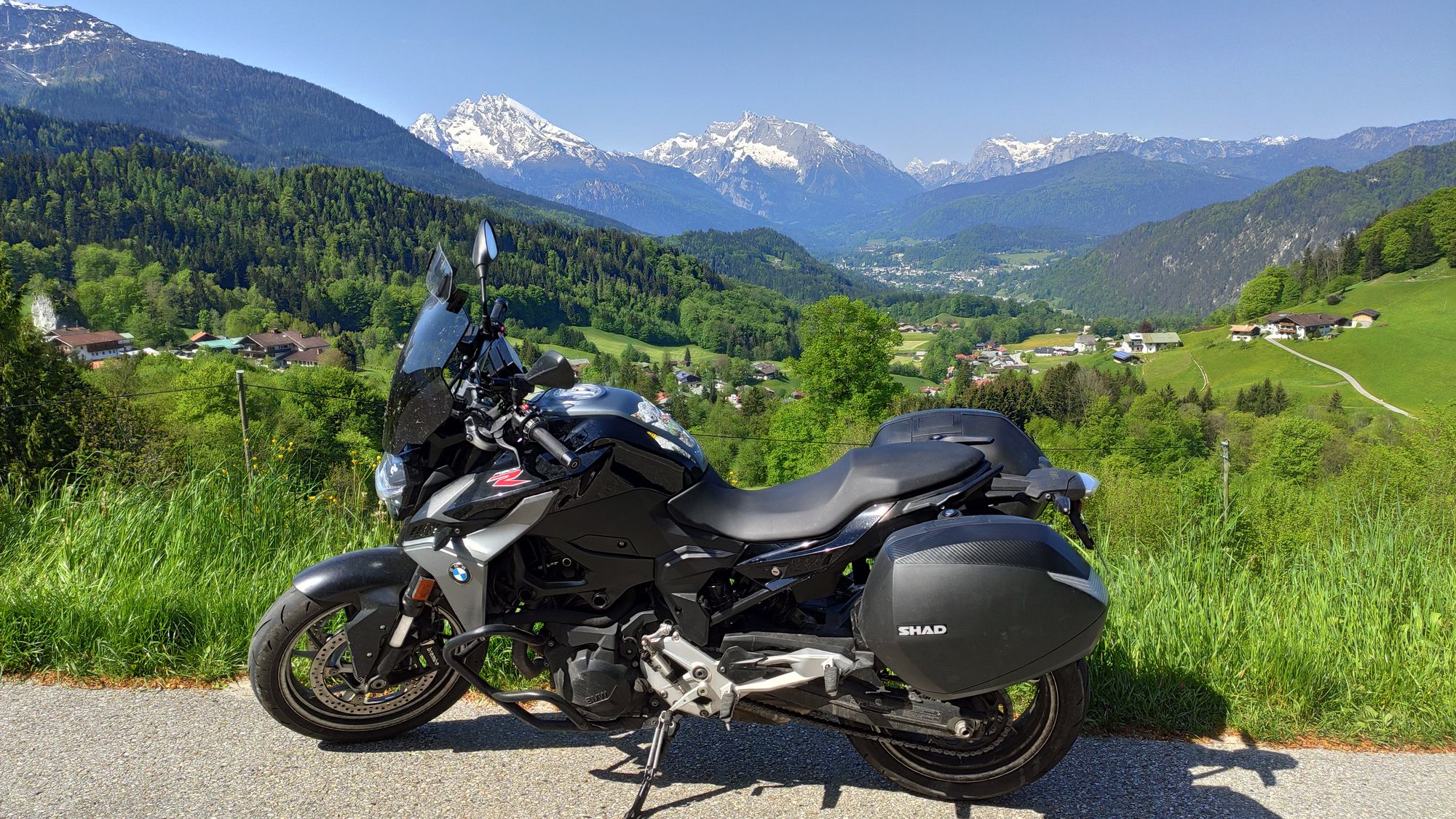
We traveled by motorcycle. In my opinion, it is the most convenient transport for these short hops: maximum freedom and no parking problems. I should note that warm gloves are necessary in addition to summer ones, even if you have heated grips. A chain for jackets and helmets will also be very useful, so you do not have to carry those awkward bulky things around and can leave them at the parking spot. We did not think of that, unlike other motorcyclists.
Day 1. Munich
The city is beautiful, wealthy, and well kept. Not Berlin, at least not the western part. There are far too many cameras on the roads around it - literally everywhere, which is surprising for Germany.
There is a BMW museum here in two neighboring buildings: BMW Welt and BMW Museum. The first has modern cars and motorcycles, where you can climb onto the whole model range, and the second is about history. It was interesting, but below my expectations. Free parking for BMW motorcycles is right at the museum entrance. For plebeians on other brands, parking is far away :)
Nymphenburg Palace is impressive, but almost immediately boring. Still worth visiting: it is one of the city’s main sights.
The city center is gorgeous and deserves several hours. Unfortunately, we did not have time for Hofbrauhaus Munich.
In the evening we relaxed in a park. Our hotel was near Perlachpark, so that is where we went.
There was one unpleasant incident. For the first time in our lives, we bought day tickets for the metro so we could drink beer in pubs, but that day there was a strike and the metro was not running >_<
Day 2. Road to Salzburg
Not actually to Salzburg, but to a small town nearby: Hallein, in Austria right on the German border. Over those two days we crossed that border about twenty times.
We chose the place well: very high quality accommodation for low prices, wonderful nature, and right in the middle of all the interesting places I had picked.
We deliberately decided to ride from Munich without using autobahns, and it was magnificent. We stopped at a tavern near Lake Zwingsee, with absolutely crystal-clear water. That day we simply rested in Hallein and did not go anywhere.
Day 3. Berchtesgaden
A very packed day. The Eisriesenwelt ice caves are highly recommended. Unexpectedly, the road there turned out to be no less beautiful, with views from above over a small town and a castle - indescribable feelings from mountain roads climbing on a motorcycle.
Maria Gern turned out to be a simple little church, but there was a soulful tavern nearby. We sat in a beer garden at Konigssee and soaked our feet there. Beautiful.
Day 4. The Eagle’s Nest
A very packed day. The Rossfeld Panorama Strasse is an outrageously beautiful alpine panoramic road among the snow.
And The Eagle’s Nest near Berchtesgaden, the “summer house” of one historical figure, with marvelous views. One of the brightest impressions of the trip.
We reached cozy Innsbruck in the evening, though we stopped in Salzburg on the way.
The plan for the next day was Germany’s highest point: Zugspitze, 2962 m. The webcams on its website showed absolutely mind-blowing views.
Day 5. Innsbruck
The mountain peaks were completely covered. Going to Zugspitze was pointless - there was impenetrable fog. We tried to wait it out over breakfast at Hard Rock Cafe, but nothing changed.
We used plan B and took the funicular up to 2334 m. Innsbruck lay in the palm of our hand, even if clouds kept drifting over it.
And on the other side of the mountains there was snow…
The ticket also included the alpine zoo, which turned out to be surprisingly well above expectations. This was the only fully urban day of the whole trip.
Day 6. Neuschwanstein Castle
In the morning I checked Zugspitze again. Fog again. We would not see anything, so going there would just waste time and money. Sad. This was a day of extremely nasty weather and pouring rain. The only one of the whole trip. How good it was that we had rain suits and membrane socks.
On the way we stopped in Mittenwald. People there are very curious, and in five minutes three different people came up to ask us about the trip.
One of the brightest points of the journey was waiting for us: Neuschwanstein Castle. Tickets must be bought well in advance, and being even 5 minutes late burns the ticket. The castle has simply wonderful paintings in a unified style, but it was never finished because of the owner’s death. Interestingly, an internal telephone line was installed during construction: the castle is fairly new, only about a century and a half old.
After that came Fussen, which we rode past. We had wanted to stop there for an hour and a half, but because of the rain we were no longer in the mood, and the castle had already given us plenty of impressions.
Then it was time for Lake Bodensee. We did not stay in Lindau itself, but in a small town right next to it: Wasserburg. A very quiet and peaceful place.
Day 7. Lindau, Liechtenstein
We wanted to spend the whole day in meditative rest, but instead visited four countries within an hour: we dipped our feet in a perfectly clear alpine lake in Switzerland, where we walked in on foot because we did not have a Swiss vignette, and then drove through Austria to Liechtenstein to see Vaduz, but it was closed.
The nature in Liechtenstein is magnificent. Almost every point on the mountain roads east of Triesenberg is a viewpoint.
We lingered, stuck on the views, and reached Lindau only in the early evening, where we caught the sunset.
P.S. A month later we were surprised by the mobile internet bill: it turns out Liechtenstein is not covered by the common European tariffs.
Day 8. Hohenzollern Castle
Hohenzollern is a less majestic castle than Neuschwanstein, but the view of it is much better. Everyone stops a couple of kilometers away to take photos. Nearby, a small group of old daredevils were launching fixed-wing drones with three-meter wingspans. This castle is convenient, welcoming, and pleasant, but it did not make the same grand impression as Neuschwanstein.
The small town of Empfingen was a transit point, and I did not expect to find anything there. I was looking for cheap lodging and found it in a very unusual half-timbered house with centuries of history. Accommodation on this whole trip was paradoxical in price: cost was inversely proportional to quality. And this little house cost next to nothing by local standards.
And unexpectedly, there was something to see just three kilometers away: the ruined Burgruine Wehrstein fortress from the early 13th century. There were no tourists there except us, and a sign nearby said: “Enter at your own risk.” We took the risk, climbed the hill, and got new impressions. Once we were already at the top, we found a trail that would have made the ascent easier. It is especially nice that near interesting landmarks there is always a stand with leaflets about the history and features of the place. Even somewhere on a mountain in the middle of nowhere.
Day 9. Black Forest, Strasbourg
The first point on the route was the source of the Danube, Donaueschingen. An impressive place, but for about ten minutes.
We stopped at the Triberg Waterfalls in the Black Forest. We spent two hours on a sweaty, difficult hiking route, and later it turned out that a couple of kilometers north along the road there was a paid entrance only a few hundred meters from the waterfall >_<
We rented accommodation not in Strasbourg but in Kehl, a town on the other side of the river, and walked to Strasbourg. Kehl is the worst German town I have seen, with disgusting infrastructure and broken roads.
And once we got to Strasbourg, we realized we had been wrong to think German service was the worst. Strasbourg is an absolute mess of a city: the tram does not follow the schedule or the route, and can simply stop for 20 minutes without opening the doors. There is dirt and garbage everywhere, junk on central streets from homeless people, some with children, who are selling it. People just yell everywhere at full volume; in Germany we had fallen out of the habit of that.
And the most unpleasant thing was that we did not know one feature of France: you need to reserve a table a day before visiting a restaurant, even the shabbiest one. In the end we spent an hour and a half looking for somewhere to have dinner. The center is beautiful and has many interesting places, if you close your eyes to the trash, the howling, and your growling stomach.
Day 10. Nuremberg
The city we rode past was Heidelberg. That was a mistake: it is absolutely worth staying there for a day, very well kept and full of points of interest for tourists. I would replace Strasbourg or Nuremberg with it. But we went to Nuremberg.
Just beyond Heidelberg there are several semi-ruined fortresses, and we stopped at one of them: Swallow Nest Castle. A pleasant place.
Nuremberg is a cheap city, unlike wildly expensive Munich, even though it is very close. And there are lots of little flies here; at this time of year they swirl through the air in clouds. You must not make the mistake that, judging by appearances, only I made in this city: wearing yellow clothes. Because they are damn attracted to that color, specifically that color.
It has a lovely city center, a curious fountain, a large city fortress, and all the tourist conveniences we had lost the habit of in France the day before.